


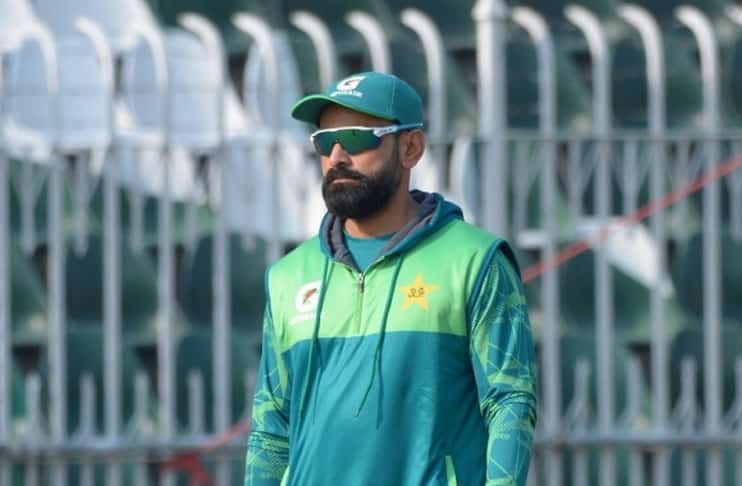
LAHORE: Former Pakistan captain Mohammad Hafeez has criticised the strategy of preparing spin-friendly pitches for bilateral series, arguing that the approach has repeatedly failed to translate into success at major ICC tournaments.
Hafeez shared his views on social media amid Pakistan’s 2-1 ODI series victory over Australia, a contest played entirely on slow surfaces that heavily favoured spin bowling.
The three-match series began in Rawalpindi before moving to Lahore for the remaining fixtures, with spinners playing a decisive role throughout.
Reacting to the conditions, Hafeez suggested that winning home bilateral contests on turning tracks does little to prepare teams for the challenges of global tournaments.
“Winning bilateral white ball series on spin conducive conditions is tested & failed formula for ICC events,” Mohammad Hafeez wrote on X.
The former all-rounder further added the hashtag “#Bangladesh”, a reference many interpreted as a comparison with Bangladesh’s long-standing strategy of producing spin-friendly home surfaces.
While the Tigers have often enjoyed success in home bilateral cricket, they have struggled to replicate those performances consistently at ICC events.
Follow us on our Official WhatsApp channel
Mohammad Hafeez’s remarks come amid an ongoing debate regarding Pakistan’s preparation for the ICC Men’s Cricket World Cup 2027, which will be jointly hosted by South Africa, Zimbabwe and Namibia.
Several former cricketers and analysts questioned whether spin-dominated pitches were the right preparation for a tournament expected to feature a variety of conditions, particularly in South Africa.
Pakistan white-ball head coach Mike Hesson, however, defended the team’s approach and rejected the criticism after the series opener against Australia in Rawalpindi.
Responding to concerns, the former New Zealand coach pointed out that the World Cup will not be played exclusively in South Africa and noted that spin is likely to be a significant factor at some venues in Zimbabwe and Namibia.
“Firstly the World Cup is jointly hosted in South Africa, Zimbabwe and Namibia. Zimbabwe and Namibia have venues where spin is a big factor and we will be playing matches in those countries,” Hesson stated.
He also challenged the perception that South African conditions are universally fast and bouncy.
“The myth of all pitches in South Africa being quick and bouncy are just not true, there are definitely some which are but they also vary throughout the country,” he explained.
READ: Shreyas Iyer set to replace Suryakumar Yadav as India T20I captain
