




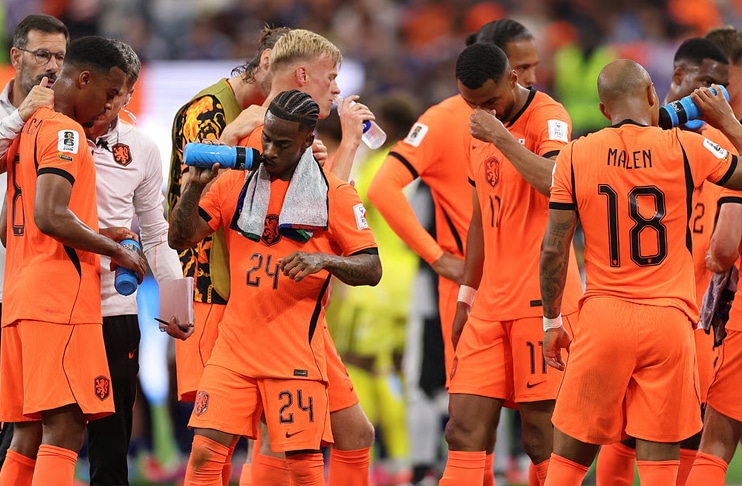
Netherlands captain Virgil van Dijk has added to the growing voices against the mandatory hydration breaks that pause every FIFA World Cup match twice.
The ongoing tournament has just begun and has already delivered dramatic goals, surprise results and unforgettable moments. However, the mandatory hydration breaks have sparked debate among fans as well as current and former players.
FIFA insists the breaks are essential for player welfare. Critics, however, are asking a different question: are these stoppages really about protecting players, or are they creating new opportunities to generate revenue?
Hydration breaks last just a total of six minutes during a match, but they stand accused of fundamentally changing the nature of football at the sport’s ultimate showpiece.
“Hydration breaks are a bit interesting,” said Netherlands captain Van Dijk, whose side drew 2-2 with Japan in Texas on Sunday in an air-conditioned arena.
“I was watching almost all of the games up until today, and every time going into a commercial is a bit… not really that I like it.
“I think for the neutral watchers on TV it’s also not great.”
Catch all FIFA World Cup 2026 live updates here!
Van Dijk was particularly puzzled by the fact that the breaks were enforced even in comfortable indoor conditions where extreme heat was not a factor.
“If it’s really hot, obviously it would be good to put them in,” he said. “But I think you have to look at it in every game separately, in my opinion.”
For many traditional football supporters, the issue is not the six minutes lost during a match. Instead, it is what those interruptions represent.
Football has always been built around two uninterrupted halves, creating momentum, pressure and rhythm that can change within seconds.
Critics argue that mandatory breaks risk turning football into a stop-start spectacle more commonly associated with American sports.
That concern intensified when FIFA later confirmed that broadcasters would be permitted to show advertisements during the hydration breaks.
Suddenly, what had been presented purely as a welfare measure started looking far more commercial to some observers.
British football writer Henry Winter was among those who voiced concerns.
Follow us on our Official WhatsApp channel
“This is the year when the game of two halves became the game of four quarters,” he said. “And the greatest sport and event was damaged for fistfuls of dollars.”
Notably, spectators during Sweden’s 5-1 thrashing of Tunisia in Monterrey on Sunday made their disdain plain by booing loudly when the pause came in the first half.
Fans similarly jeered the break in Monday’s game between Spain and Cape Verde in the air-conditioned arena in Atlanta.
The scheduled drinks breaks, not normally part of football, last three minutes each, about midway through both halves of a game at the tournament in North America.
Moreover, there is a concern that these breaks might affect the natural flow of matches.
While there is no hard evidence yet, several matches have featured noticeable momentum shifts immediately after the stoppages. That should not be surprising.
Hydration breaks effectively give coaches two extra opportunities each half to speak directly with players, adjust tactics and address problems.
In some cases, they can feel like unofficial time-outs. A team struggling to cope with pressure suddenly receives a chance to regroup. Conversely, a side dominating possession can lose rhythm and intensity.
